Pages

Friday, 24 June 2011

Norwich at war

scan0001
GOOD quality local books have a remarkably long shelf-life. Take “Norwich at War” for example by Joan Banger. First published in 1974 it it now in its third incarnation and seems to be something of a best seller at the excellent City Bookshop in Davey Place, Norwich.  I would imagine a lot of the latest wave of interest has been sparked by the incredible mash-up photos which merge old and new in an eerily poignant way. Then there’s a new book – according to this Evening News article – being planned by Steve Snelling to tie in with the 70th anniversary of the raids next April. I’d love to know how many new eye-witnesses Steve has unearthed, because the sad fact is that generation will not be with us much longer. I need to know more about the impact of the bombings in the Heigham area for my book and Norwich at War is packed with devastating detail. Walking around both central Norwich and Heigham will never be quite the same again. 
* More on those mash-ups here.

Thursday, 16 June 2011

Baedeker memories please

sunny march 027
HEIGHAM is a funny old part of Norwich these days. Too close to be a suburb, yet not far enough away to have its own identity. Its north-eastern boundary is the Wensum of course, so the Heigham chapter will come after Hellesdon and before Norwich Over the Water. In earlier generations Heigham was much more of a community, but It quickly becomes clear that this section will be dominated by what happened on April 27th 1942. That was the first night of the so-called Baedeker bombings on the city (in retaliation for the Allied bombing of Lubeck the previous month). Heigham copped it big time. Among the buildings hit was St Bartholmew’s Church. As this modern picture shows, only the tower survived. As for the wider damage, this is one account from “Joan P” recorded for a Women’s Oral History Group pamphlet on Heigham Street published in 1991.
“Of course everywhere was devastated, that took a long while. Bullens was on fire, Cushions was on fire, Wincarnis was on fire, the Picture Palace at the back. The Mayfair was on fire – Old Mother Reilly was on there then. But everywhere was devastated. We actually saw Bullens burn down and we could have put it out but there was no water.”
And through our consumerist eyes I find this section poignant too:
“We had no clothes, just what we were standing up in. Mother, she salvaged the settee and two chairs and of course all the bed linen. They were not much good. But a tracer bullet went through the settee, so we had that marked afterwards. We had that for quite a while afterwards because there was nothing else.”
I love the fact that even a bullet through a sofa wasn’t a good enough reason to get rid of a piece of furniture, such were the hardships.
So can anyone out there remember that awful night in Heigham? Has anyone got any photos – particularly any before and afters? Do get in touch if you or a relative can help. Email me direct on sanddsilk@btinternet.com.
Oh and just finally, there’s much on the church and the raids, on Simon Knott’s ever-erudite website. Here’s a taster: 
“As St Benedict's Street becomes Dereham Road, it does not make for one of central Norwich's more attractive districts. The vast Toys R Us superstore and its companions are an unlikely and unwitting legacy of the Luftwaffe's work.”

Sunday, 22 May 2011

Kayaking the Yare: Part Five

095
EVERY day thousands of Norwich commuters come off the southern bypass at Trowse and drive into the city on an extended bridge across two rivers. And every day for the last eight years this particular commuter has stared down at the mix of the river and railway to his left and thought he really must go exploring one day. I finally managed it yesterday.
124
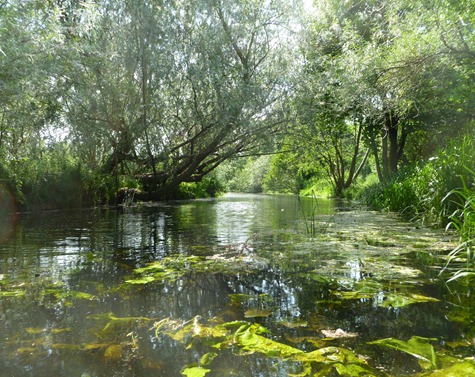
The rivers are the Yare and the Tas. And the best place to get the kayak into the former, is at The Cock in Lakenham, a welcoming riverside pub with a packed beer garden yesterday afternoon. True, the  many “Drugs will not be tolerated” posters were a tad off-putting, but everything else was perfect. The remains of Lakenham Mill mean you can’t go upstream from here (but there is another way) and the water is very shallow downstream. But within a hundred yards you get deeper water and come across the sort of Claude Monet scenery seen in the top photo.
Bridge of sighs
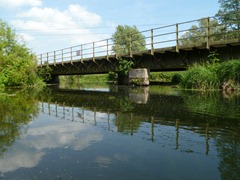
Heading downstream you shoot the main railway line which is – brilliantly - known as the Bridge of Sighs – even if you will have to click on the photo (right) to get documentary evidence. From there you pass under the much taller bypass bridge before being pulled up by floating barriers just upstream of Trowse Mill. The restrictions imposed by Trowse and Lakenham mills do make this a slightly frustrating stretch but as ever
104
there was a great “getting away from it all” feeling, surprisingly close to the city. Blue, black and red damselflies flitted everywhere, a swan fiercely saw me off his territory and Flag Iris bloomed. And that – give or take the odd 100 yards  – means I’ve done the Yare from Bawburgh down to its confluence with the Wensum at Trowse Eye.
Heading back there was a web of other more modest channels to explore. It quickly becomes clear that the only one going anywhere is the River Tas. Looking at the map afterwards one assumes that the Victorians must have dug a new route for the Tas alongside the railway here. I didn’t get any further than the bridge carrying the Lakenham to Caistor road, but at least I know where to start next time. With the Yare ticked off, the Tas has to be next. It has inspired poet Cameron Self to write “River”, and the Norfolk fisherman John Wilson describes its waters as “gin-clear”. Watch this space.
* Lots more Kayaking Kapers on the Yare here.

Saturday, 21 May 2011

Another bridge over the Wensum

New Broads Bridge

MONDAY sees the start of work on yet another bridge over the River Wensum in Norwich. The bridge – as yet unnamed – will connect the Broads Authority offices on the north side of the river to the area behind the law courts. The job should be completed by mid-November. The last new bridge was the Lady Julian in 2009 with the Novi Sad some seven years earlier. I’m a big fan of these new bridges. They help people reconnect with the river. Where’s the next one going to go?

* Pictures shows artist’s impression courtesy of Broads Authority.

Friday, 6 May 2011

Kayaking the Yare–the full picture

Bawburgh to Earlham 0411 069
TWO requests have flooded in to see photos on my kayaking trips along the Yare on a map. Not least because the river takes such a tortuous route around suburban Norwich that it’s difficult to envisage what goes where – hence the need for my book I would argue.
So with a little help of flickr and googlemaps you can see the full picture here. Remember to click on “map” for pinpoint geotastic accuracy.
I did Bawburgh to Lakenham in four separate trips – two this spring and two last October. You can see the write-ups for each one on my sister website: Wherryman’s Way. Direct links are below:
1) Bawburgh to Earlham Park
2) Earlham Park to Cringleford
3) Harford Bridges to Eaton
4) Lakenham to Harford
Next up: the last leg of the Yare from Lakenham down to Trowse. I’ll also try the River Tas.

Tuesday, 12 April 2011

The confusing legend of St Edmund

hellesdon edmund crop

KING EDMUND – of Bury St Edmunds fame - died in 869 at the hands of the Danes. And the legend tells us that he was martyred at a place called 'Hægelisdun'. But where’s that? It could be Hellesdon and, as this image on the sign makes clear, the Norwich village/suburb is happy to claim him. That’s St Edmund lying motionless on the floor. The animal is a wolf. The legend says that St Edmund’s severed head was found between the paws of an uncharacteristically meek wolf, so they’ve spared us the full gruesome horror in this 20th century version.

But was it really Hellesdon? The excellent hiddenea website, makes clear that Hellesdon is one of only five possible locations. So Hoxne, Hollesley etc will all need a mention too.

I struggle to summarise these saintly tales. I had to write the Legend of Lodbrog (Reedham) for the Wherryman’s Way book while St Walstan will come under Taverham in this one. The better the miracle the better the story to medieval eyes. The better the miracle the more ridiculous it seems to modern sensibilities. Try this from wikipedia for example:

“His severed head was thrown into the wood. Day and night as Edmund's followers went seeking, calling out "Where are you, friend?" the head would answer, "Here, here, here," until at last, "a great wonder", they found Edmund's head in the possession of a grey wolf,  clasped between its paws. "They were astonished at the wolf's guardianship".The wolf, sent by God to protect the head from the animals of the forest, was starving but did not eat the head for all the days it was lost. After recovering the head, the villagers marched back to the kingdom, praising God and the wolf that served him. The wolf walked beside them as if tame all the way to the town, after which it turned around and vanished into the forest.”

So what do I do? Tell it straight as though I believe every word? Ladle on the irony and risk looking smug? But then has anyone every believed it? After all, towns battled for the right to be connected to saints for the money the pilgrims brought to the local economy. At the end of the day it all seems a bit Loch Ness Monster.

Sunday, 3 April 2011

Help me with Hellesdon

sunny march 101
MY COSTESSEY chapter is all but done, so now it’s onto Hellesdon which feels a bit of a challenge in comparison. Costessey had a posh manor house, a fascinating Catholic history and Alfred Munnings. Hellesdon has a big chemicals factory and err, lots of houses? To be fair this sprawling suburb does have a historic heart and most of it can be found close to the river. So far, I plan pieces on the remains of both Hellesdon Mill and Hellesdon railway station. (Scene of that great mash up picture mentioned last month.) The chemicals
Marriotts 0311 121factory is owned by Bayer Crop Science, but has seen previous incarnations as May & Baker, Rhone-Poulenc and Aventis so there will be something there, while the 12th century church (pictured) and Marriotts Way will also need more than a mention. River access is great. You can get a canoe in all the way along Hellesdon Road and Hellesdon Mill Lane, though I’m not sure how you get to the Wensum upstream of the mill. What else am I missing? Who can remember the railway? I’d love to talk to a 1950s Hellesdon commuter. And where can I find photos of the mill? Over to you guys…..